
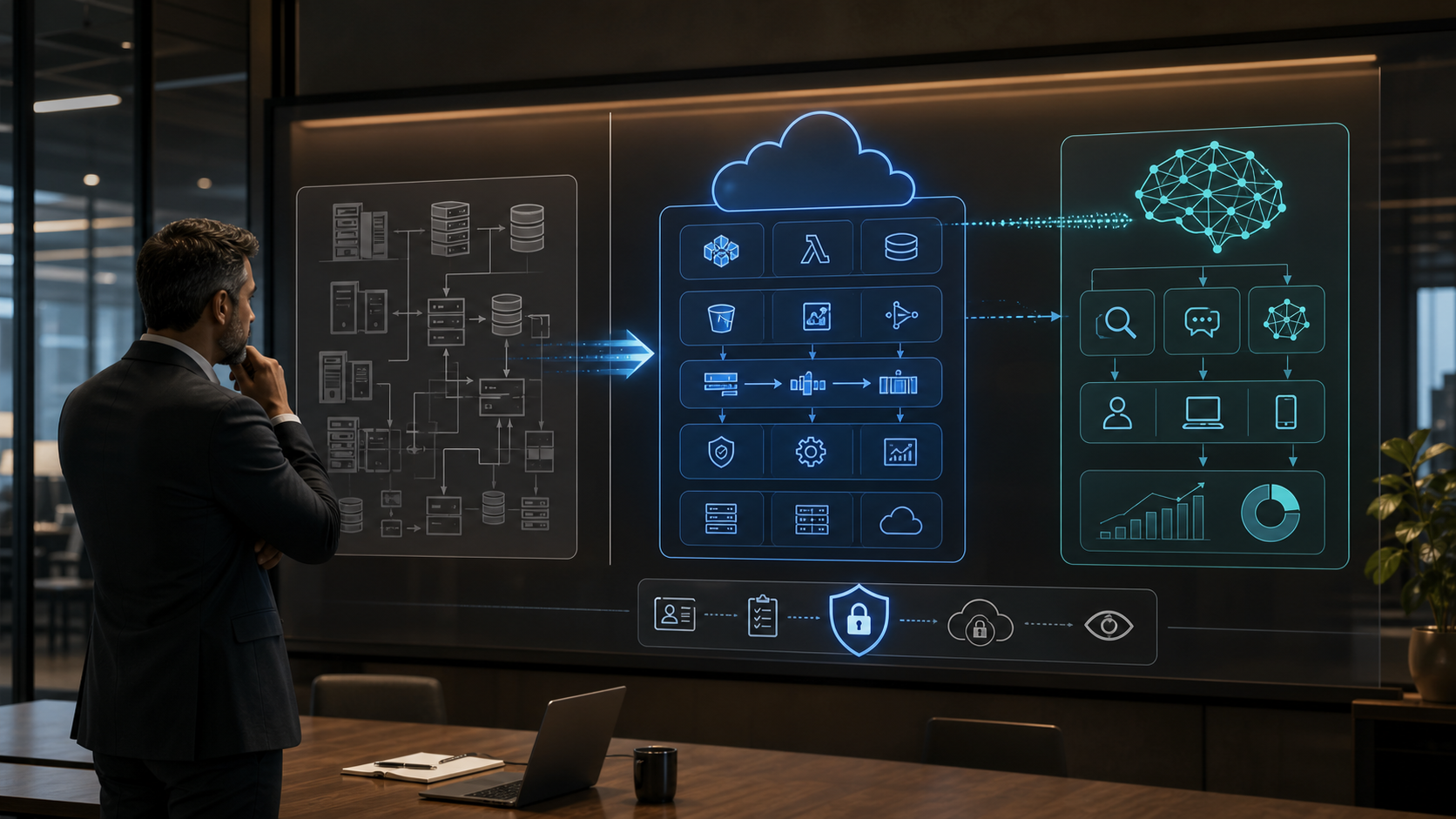
AI exposes weak platforms because it depends on clean data, reliable systems, secure access, and observable workflows.
Modernization should start with the workflow that AI must improve, not a broad infrastructure wishlist.
The right cloud roadmap links cost, security, delivery speed, and AI readiness.
AI exposes weak platforms
AI does not magically modernize a company. In many cases, it exposes how outdated the platform already is. Fragmented data, brittle integrations, manual exports, inconsistent permissions, and legacy workflows become more painful when the company tries to add intelligent automation on top.
That is why cloud modernization often has to come before serious AI adoption. Not every system needs to be rebuilt, but the workflows that feed AI need reliable data, secure access, observable behavior, and scalable infrastructure.
Modernize the workflow first
The worst modernization projects begin with infrastructure fashion. The best ones begin with workflow reality. What process is slow, manual, error-prone, expensive, or customer-visible? What systems does it touch? Where does data break down? Which people are compensating for bad architecture with manual effort?
Once the workflow is clear, the modernization path becomes more practical. Some applications need migration. Some need APIs. Some need data pipelines. Some need identity cleanup. Some simply need to be retired.
Data readiness is AI readiness
AI systems depend on data availability and context. If customer records live in disconnected systems, if knowledge articles are outdated, if permissions are inconsistent, or if operational data is not trustworthy, the AI output will reflect that weakness. The model may be advanced, but the company context will be broken.
A fractional CTO should make data readiness visible as an executive dependency. That includes ownership, quality, lineage, access, retention, and governance. AI readiness is not a model checklist. It is a data operating model.
Security cannot be bolted on later
Cloud modernization for AI must include identity, secrets management, encryption, logging, network controls, vulnerability management, and incident response. AI workflows often increase the blast radius because they connect knowledge, systems, and automated actions. That makes security design part of the foundation.
If a company wants AI agents to take action, the cloud platform must know who is allowed to do what, under which conditions, and with what audit trail. Without that, automation becomes a liability.
Cost discipline matters
AI can make cloud spend less predictable. Inference calls, vector databases, data movement, logging, and usage growth can create surprise costs. A modern platform needs cost visibility from the start. That means tagging, budgets, usage dashboards, and architectural decisions that account for volume.
Cost discipline is not about being cheap. It is about making sure the economics of the AI workflow work at scale. An AI workflow that costs too much per transaction is not a product strategy.
The modernization sequence
I would sequence modernization around the highest-value AI-enabled workflow. Clean up the workflow, connect the data, modernize the platform components, implement the security baseline, and then introduce AI where it can produce measurable leverage. This is more disciplined than a broad cloud transformation that never reaches the customer.
The company does not need a perfect cloud estate to start. It needs a credible modernization path tied to business outcomes. That is the difference between moving workloads and building a platform for growth.
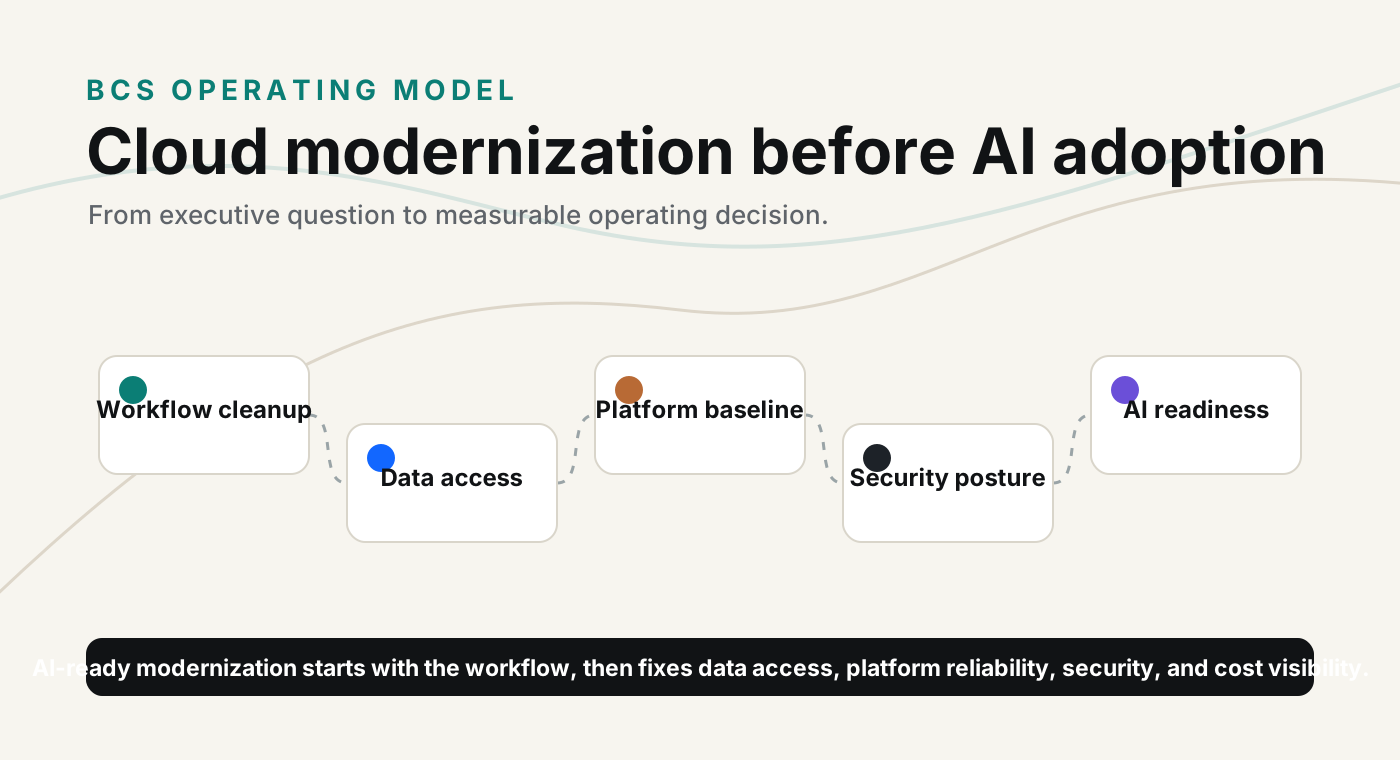
Operating flow
The practical sequence I would use to turn this idea into a working executive plan.
Metrics I would watch
Every serious engagement needs a scorecard. For this topic, I would start with these signals and refine them based on the business model, sales cycle, risk profile, and stage of the company.
- Deployment frequency
- Downtime reduction
- Data availability for target workflows
- Cloud spend per workflow
- Security control coverage
- AI production readiness score
How I would apply this
Turn the article into operating decisions.
Identify the workflows that need AI support and trace the systems they depend on.
Fix identity, logging, secrets, environment separation, and data access before scaling AI adoption.
Use FinOps and platform metrics so successful AI usage does not create unmanaged cost.
Questions worth answering before the next meeting
- Which workflow is blocked by platform debt?
- What data must become reliable before AI is useful?
- Where does modernization reduce both risk and cost?
Where BCS fits
BCS can help as a fractional CTO to sequence cloud modernization around AI readiness, delivery speed, security, and cost governance.
Discuss this engagement