

Activity becomes traction only when it creates customer proof, revenue signal, or investor confidence.
The founder operating cadence must force tradeoffs across product, sales, hiring, and capital.
A fractional CEO helps install weekly accountability without waiting for a full-time executive search.
Activity is not traction
Startups can look busy while standing still. The calendar is full, the product backlog is growing, the website is changing, investors are being updated, and the team is talking to prospects. But when you ask what evidence has improved in the last four weeks, the room gets quiet. That gap is exactly where fractional CEO work can matter.
A fractional CEO is not there to replace the founder's ambition. The role is to bring operating discipline to a messy stage. The company needs sharper choices, cleaner accountability, and a way to turn motion into proof. Traction is not a vibe. It is evidence that the market is pulling the company forward.
The founder bottleneck
In many early companies, every decision runs through the founder. Product questions, pricing questions, hiring decisions, customer escalations, investor updates, and marketing copy all compete for the same attention. The founder becomes the router for the entire company, and the company slows down while everyone waits for clarity.
A fractional CEO can help install decision rules. Which decisions require founder involvement? Which decisions belong to product, sales, engineering, or marketing? Which metrics decide whether a bet continues? This is not corporate bureaucracy. It is how a company protects founder energy for the few decisions only the founder can make.
Resetting the operating cadence
I would begin with a weekly operating rhythm built around traction signals. The team should review customer conversations, qualified pipeline, product delivery, cash, partner momentum, and the one or two constraints blocking progress. A good cadence makes reality harder to avoid. It also reduces random acts of urgency because the company knows when and where decisions get made.
The operating meeting should not become a status parade. Every update should end in a decision, a risk, or a request. If the meeting does not change what happens next, it is not creating operating value. A fractional CEO should be disciplined about that because young companies cannot afford performative alignment.
Customer proof before investor polish
Founders often spend too much time perfecting the investor story before the customer story is strong enough. Investors can feel that. A cleaner pitch deck cannot compensate for vague buyer pain, weak urgency, unclear pricing, or a product that has not been tested in the conditions where it must create value.
The best investor narrative comes from customer proof. Who has the problem? What are they doing now? Why is the current workaround painful? Did they commit time, data, budget, a referral, a partnership path, or a contract? A fractional CEO helps the team collect that evidence and turn it into a credible growth story.
The first 30 days
My first 30 days would focus on focus itself. I would map the current initiatives, cut or pause anything that does not support the next traction milestone, define the operating scorecard, review the pipeline, listen to customer calls, and pressure-test the company narrative. I would also identify whether the problem is strategy, execution, messaging, product readiness, or leadership bandwidth.
The output should be a traction plan the team can execute immediately: the target customer, the offer, the proof needed, the outreach motion, the product commitments, and the weekly review cycle. The plan should be simple enough to run and specific enough to expose whether it is working.
What good fractional CEO help should leave behind
The company should become clearer after the engagement. The team should know what matters, what does not, who owns each decision, and how traction is measured. The founder should feel more leveraged, not more managed. Investors should hear a sharper story. Customers should experience a company that understands its own promise.
The real deliverable is operating maturity. A fractional CEO should help the company build the muscles it will need when it eventually hires permanent executives: cadence, judgment, accountability, narrative, and customer-centered decision-making.
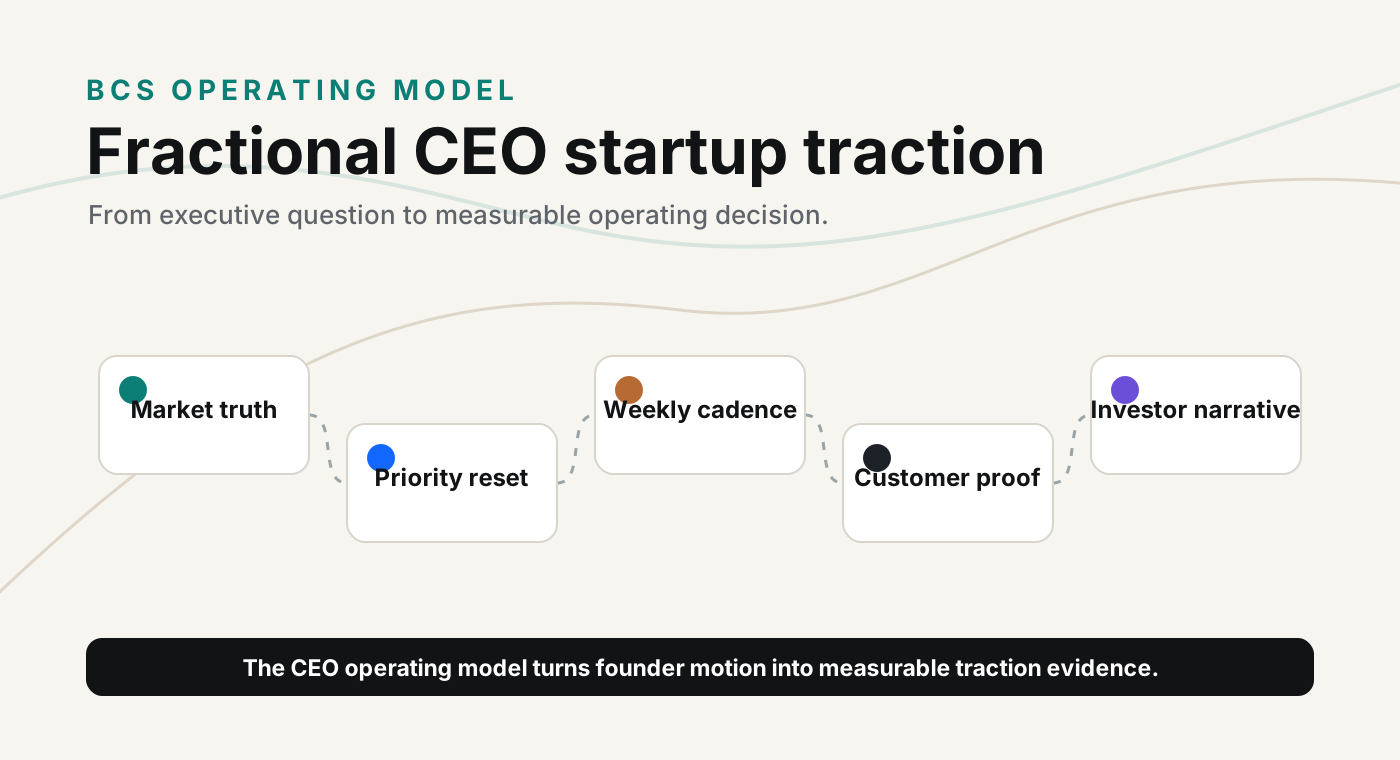
Operating flow
The practical sequence I would use to turn this idea into a working executive plan.
Metrics I would watch
Every serious engagement needs a scorecard. For this topic, I would start with these signals and refine them based on the business model, sales cycle, risk profile, and stage of the company.
- Qualified customer conversations per week
- Opportunity conversion rate
- Revenue pipeline by stage
- Decision cycle time
- Founder time spent on highest-value work
- Investor narrative readiness
How I would apply this
Turn the article into operating decisions.
Separate attention, interest, commitment, and revenue in the weekly scorecard.
Choose the buyer segment that gives the company the clearest proof fastest.
Turn board and investor updates into a disciplined operating rhythm, not a storytelling exercise.
Questions worth answering before the next meeting
- Which market segment gets focus this quarter?
- What proof changes the next funding conversation?
- Where is founder time being wasted?
Where BCS fits
BCS can help as a fractional CEO to sharpen priorities, install operating cadence, and turn early activity into credible traction.
Discuss this engagement