

Use cases are ranked by value, feasibility, risk, adoption, and learning.
Architecture choices are translated into budget, trust, delivery, and scale decisions.
The output is a governed AI roadmap with owners, metrics, and production criteria.
The real AI roadmap problem
Most AI roadmaps fail before the first model is chosen. They fail because the company treats AI as a list of tools instead of a sequence of business decisions. A founder hears that competitors are adding agents, a board asks about productivity, a sales leader wants a chatbot, and engineering gets handed a vague mandate to make the company AI-enabled. That is not a roadmap. That is pressure without architecture.
A fractional CTO has to slow the conversation just enough to make it useful. The first question is not which model to use. The first question is which workflow deserves executive attention. If the workflow has no measurable pain, no owner, no data path, and no customer or operational impact, then it is not ready to consume the roadmap.
Start with a use-case filter
I use a blunt filter: value, feasibility, risk, adoption, and learning. Value asks whether the use case improves revenue, retention, margin, speed, compliance, or customer experience. Feasibility asks whether the data, systems, permissions, and integrations exist. Risk asks what can go wrong if the AI behaves badly. Adoption asks who will actually use it on Monday morning. Learning asks whether the implementation creates evidence that can compound into the next initiative.
This filter protects the team from shiny-object AI. For example, a support summarization workflow may be less glamorous than a fully autonomous customer agent, but it can create immediate value, expose data quality issues, and teach the organization how to govern AI outputs. That makes it a better first move for many companies. The roadmap should earn its way toward autonomy.
Architecture is a business decision
The architecture conversation should be framed in business language. A retrieval-augmented generation pattern is not interesting because it sounds modern. It is interesting if the company needs accurate answers grounded in controlled knowledge. Fine-tuning is not a badge of sophistication. It is useful only when the behavior or domain language requires it and the data justifies the investment. Agent orchestration is not a strategy by itself. It is a strategy only when the workflow has clear permissions, state, fallback rules, and auditability.
A fractional CTO should make these tradeoffs visible to the CEO and board. Build-versus-buy, vendor risk, data residency, security controls, cost per transaction, and integration complexity are not back-office details. They determine whether the AI initiative becomes a scalable product capability or a fragile workflow that no one trusts.
The 30-day CTO sprint
In the first 30 days, I would inventory the current AI ideas, map them to business outcomes, identify the top two candidate workflows, review the data sources, inspect the existing architecture, and define the governance model. I would also name the decision owners. AI work gets messy when product, engineering, legal, compliance, sales, and support all assume someone else owns the hard calls.
The sprint should end with a one-page roadmap, not a 60-slide shrine. That roadmap should say what we are building, why it matters, what systems it touches, what risk controls are required, what success means, and what happens after the first production workflow proves value. If the team cannot answer those questions, it is not ready to scale.
What I would not do
I would not begin by buying a broad AI platform and hoping use cases appear. I would not allow disconnected teams to use customer data without governance. I would not promise autonomy before the company has handled authentication, logging, exception handling, prompt safety, human escalation, and cost monitoring. I would not let marketing announce AI capabilities that engineering cannot support in production.
I would also avoid the trap of overbuilding. Many teams respond to AI uncertainty with unnecessary architecture complexity. They create a heavy platform before proving a workflow. The better move is to design the minimum durable platform while making the scaling path explicit.
How CEO, CTO, and CMO roles connect
The CEO decides which AI bets deserve focus and how they support the company story. The CTO designs the system that can ship safely. The CMO turns the capability into market language that customers understand without exaggerating. When those three roles are disconnected, AI becomes either a science project or a risky claim. When they work together, AI becomes a credible growth lever.
This is why fractional leadership is useful for companies that are between stages. They may not need a permanent CTO yet, but they need someone who can translate ambition into architecture, budget, timeline, risk, and customer proof.
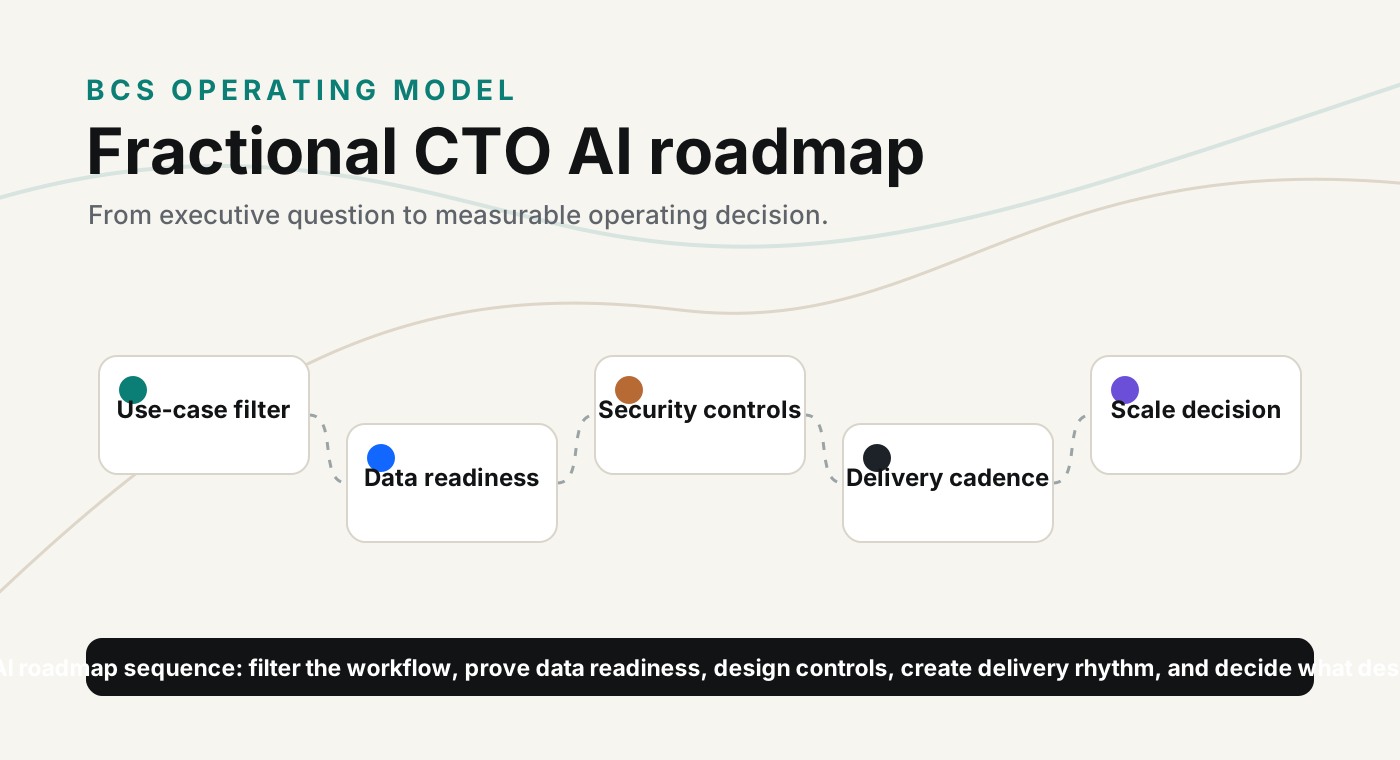
Operating flow
The practical sequence I would use to turn this idea into a working executive plan.
Metrics I would watch
Every serious engagement needs a scorecard. For this topic, I would start with these signals and refine them based on the business model, sales cycle, risk profile, and stage of the company.
- Time from idea to governed implementation
- Production workflow conversion
- Reduction in manual workflow hours
- Security exceptions closed before launch
- Cost per AI transaction
- Customer or employee adoption rate
How I would apply this
Turn the article into operating decisions.
Name one AI workflow that matters to revenue, cost, or customer experience.
Map the data, integrations, human handoff, and security controls before choosing vendors.
Create stop-or-scale criteria so the team knows when to invest, pause, or retire the workflow.
Questions worth answering before the next meeting
- Which workflow gets executive sponsorship?
- What must be true before it reaches production?
- Who owns cost, risk, adoption, and measurement?
Where BCS fits
BCS can help as a fractional CTO to convert AI ambition into a governed roadmap, architecture decisions, vendor oversight, and measurable delivery.
Discuss this engagement