

Healthcare AI only works when it respects revenue cycle reality, compliance expectations, and staff workflows.
The best starting points are narrow denial or administrative workflows with measurable financial impact.
Human review is a trust design choice, especially when protected health information and reimbursement are involved.
Healthcare AI has to respect operational reality
Healthcare AI fails when it ignores how healthcare work actually happens. Revenue cycle teams deal with payer rules, documentation gaps, coding complexity, eligibility issues, prior authorization, denial management, appeals, compliance, and staff fatigue. A generic AI promise does not survive contact with that environment.
Operator-led transformation starts with the workflow, not the model. Where is revenue leaking? Which denials repeat? Which manual touches consume staff time? Which documents are missing? Which payer patterns are predictable? These questions matter more than presentation polish.
RCM automation is not one workflow
Revenue cycle automation includes eligibility, authorization, charge capture, coding support, claim scrubbing, denial prediction, appeal drafting, payment posting, patient billing, and analytics. Each workflow has different data, risk, and human review requirements. Treating RCM as one automation category creates bad design.
A practical AI roadmap should choose the first workflow based on financial impact and feasibility. Denial triage may be a strong starting point if the organization has historical denial data and clear categories. Appeal drafting may help if documentation is available and human review remains in place.
Human review is not a weakness
In healthcare, human review is often the control that makes AI viable. The goal is not to remove every person from the process. The goal is to reduce repetitive work, surface the right evidence, recommend next steps, and help staff make better decisions faster. That distinction matters for adoption and compliance.
Staff will resist AI if it feels like a black box judging their work. They are more likely to adopt it if the system explains what it found, cites the source, shows confidence, and allows correction.
Compliance and trust by design
Healthcare AI must respect HIPAA, data access controls, auditability, vendor risk, and patient trust. If the system touches protected health information, the architecture and contracts matter. If it generates patient-facing communication, tone and accuracy matter. If it influences reimbursement, traceability matters.
The CTO and compliance leaders need to work together early. Waiting until after implementation planning to review security and privacy creates rework and slows adoption.
The CEO lens on healthcare AI
The CEO should ask whether the AI initiative improves financial performance without damaging trust. Does it reduce A/R days? Does it improve appeal success? Does it reduce staff burden? Does it help the organization respond to payer complexity? Does it create a defensible operating advantage?
Healthcare executives are right to be skeptical of vague AI claims. The strongest business case ties AI directly to workflow economics and operational resilience.
How to start responsibly
I would begin with a revenue leakage assessment, denial category analysis, workflow map, data readiness review, and a controlled implementation plan with human review. The workflow should have a narrow scope and a financial metric. It should also include staff feedback because adoption is part of the outcome.
Healthcare AI can be powerful, but only if it earns trust from operators. The best systems feel less like magic and more like a highly prepared teammate.
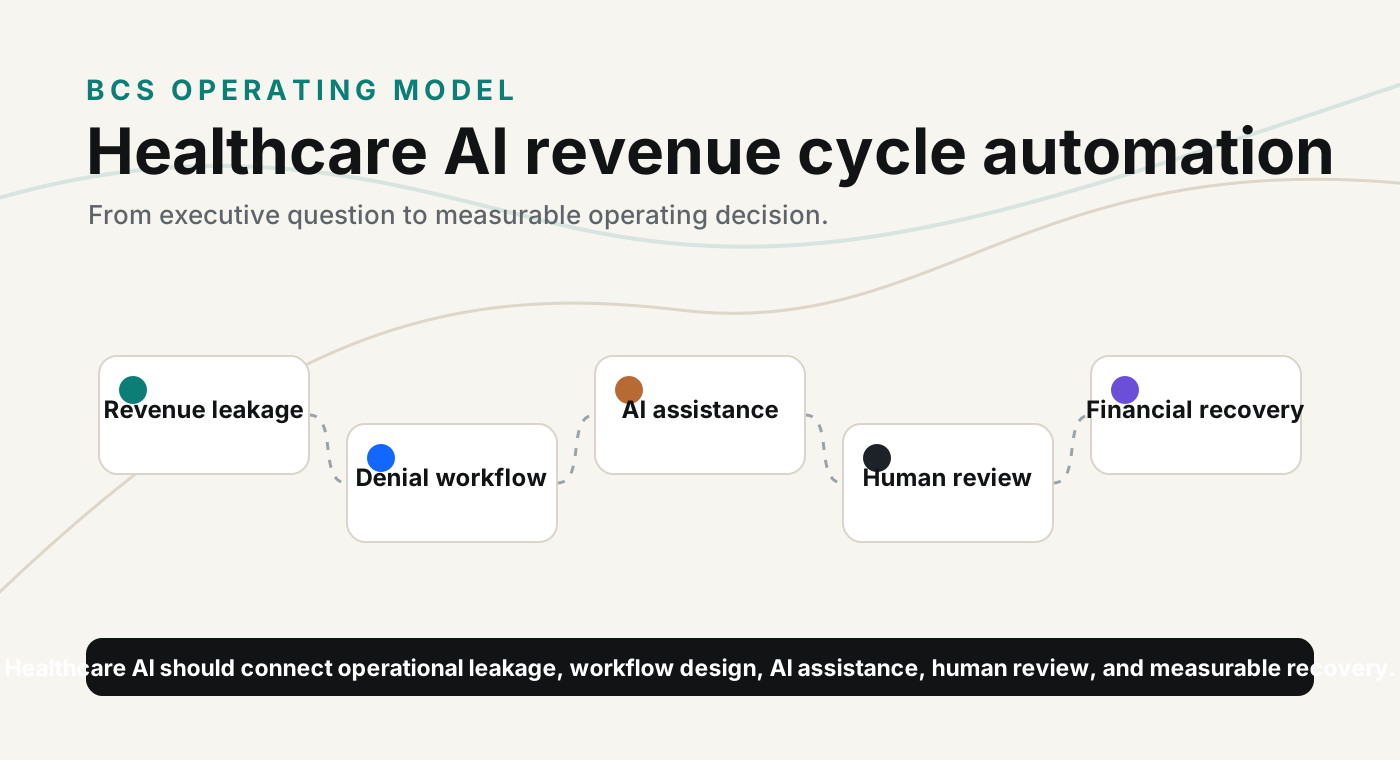
Operating flow
The practical sequence I would use to turn this idea into a working executive plan.
Metrics I would watch
Every serious engagement needs a scorecard. For this topic, I would start with these signals and refine them based on the business model, sales cycle, risk profile, and stage of the company.
- Denial resolution time
- Appeal success rate
- Manual touches per claim
- A/R days
- Staff adoption
- Net revenue recovered
How I would apply this
Turn the article into operating decisions.
Choose one recurring denial category or administrative workflow with meaningful dollars and available history.
Map PHI exposure, access control, auditability, vendor risk, and escalation before implementation.
Measure dollars recovered, staff time saved, cycle time, and user trust.
Questions worth answering before the next meeting
- Which RCM workflow has enough financial value?
- Where must human review remain mandatory?
- What compliance evidence must exist before expansion?
Where BCS fits
BCS can help healthcare AI and healthtech teams design workflow-first AI that earns operational and compliance trust.
Discuss this engagement