

An operator-investor looks for evidence that reduces uncertainty, not only a polished deck.
Founder learning velocity, customer commitment, GTM clarity, and technical risk matter before scale.
The best angel support combines capital with product, market, technical, and operating judgment.
The deck is not the company
A polished deck can hide an unfocused company. An operator-investor looks past the slides and asks how the business actually behaves. Can the founder learn quickly? Does the market show pull? Does the product solve a painful problem? Can the team ship? Can the company acquire customers without fantasy assumptions?
Early-stage due diligence is not about predicting everything. It is about identifying whether the team has the judgment and velocity to discover the truth before capital runs out.
Founder signal matters
I look for founders who can hold conviction and evidence at the same time. They should believe deeply in the problem but remain willing to change the path when customers teach them something. Coachability matters, but so does backbone. A founder who changes direction after every conversation is as risky as one who ignores every signal.
The strongest founders can explain what they have learned, what surprised them, what they were wrong about, and what they will test next. That is operator language.
Market pull beats market size
A large market is not enough. The question is whether the company has found a wedge where buyers feel urgency. Who is actively looking for the solution? What workaround are they using? What budget could shift? What event creates urgency? What makes the timing right now?
I would rather see a narrow customer segment pulling hard than a giant TAM slide with no believable entry point.
Technical diligence without theatrics
For AI and technology companies, I want to understand the architecture, data dependency, model claims, integration burden, security posture, and scalability path. I also want to know what is production-ready, what depends on manual support, and what risk remains before customer adoption.
The goal is not to punish early teams for being early. It is to separate normal startup incompleteness from dangerous technical assumptions.
Go-to-market clarity
Many startups underinvest in distribution thinking. They assume a good product will create its own demand. It rarely does. I want to know the first channel, the buyer, the champion, the sales motion, the proof point, and the reason a customer would act now.
The CMO lens matters even at the earliest stage. Positioning, category language, and customer education can determine whether a good product gets understood quickly enough.
How I help after investing
As an angel investor, capital is only part of the value. I can help founders think through product sequencing, AI and cloud architecture, customer engagement, positioning, early partnerships, and executive narrative. The work is practical: sharper questions, useful introductions, and fewer avoidable mistakes.
The best founder-investor relationships are built around truth. Optimism is required, but so is operational honesty.
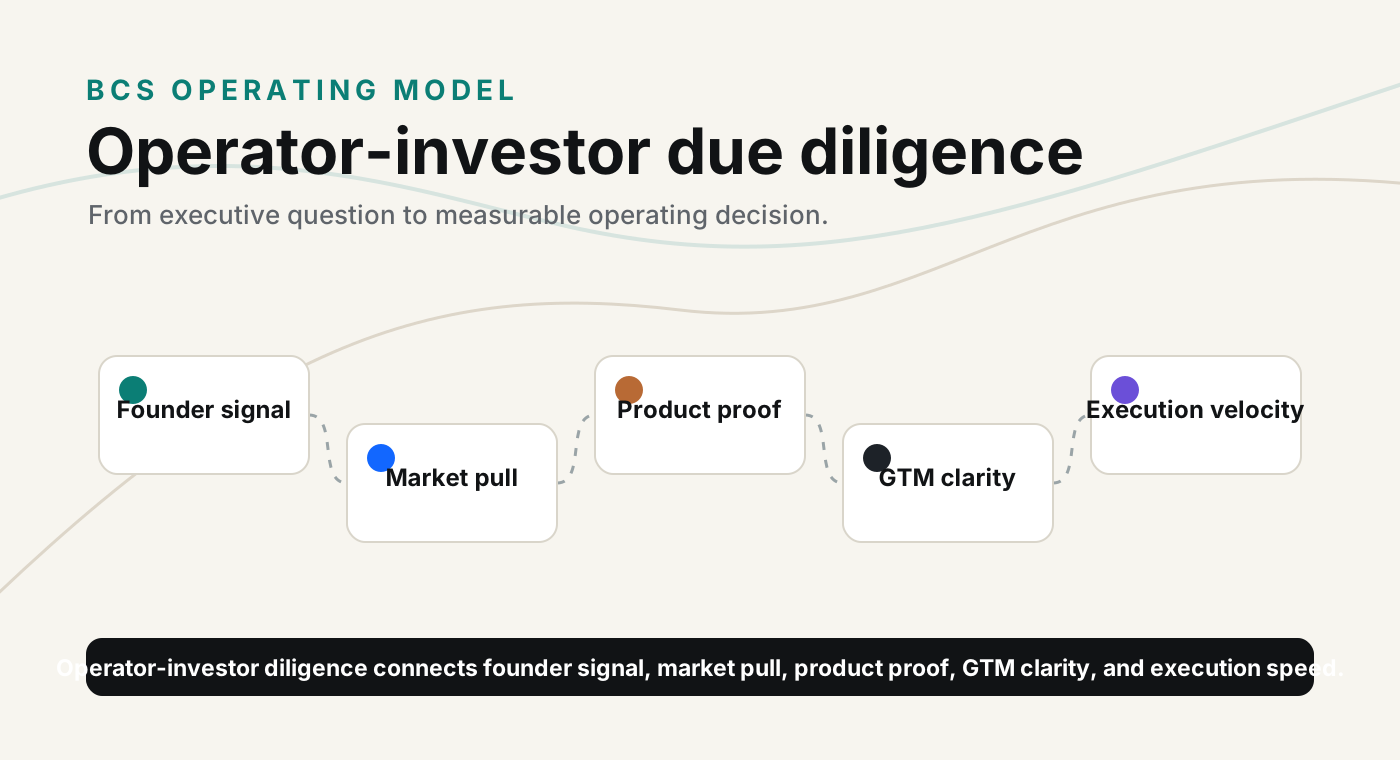
Operating flow
The practical sequence I would use to turn this idea into a working executive plan.
Metrics I would watch
Every serious engagement needs a scorecard. For this topic, I would start with these signals and refine them based on the business model, sales cycle, risk profile, and stage of the company.
- Customer discovery quality
- Customer commitment proof
- Founder learning velocity
- Technical risk retired
- Pipeline credibility
- Capital use clarity
How I would apply this
Turn the article into operating decisions.
Look for customer behavior that proves urgency, not only positive feedback.
Pressure-test the technical and go-to-market risks that could slow the next funding milestone.
Help the founder focus on the smallest set of actions that increases enterprise value.
Questions worth answering before the next meeting
- What evidence reduces the biggest uncertainty?
- Where can operator help change the company trajectory?
- What must be true before more capital is useful?
Where BCS fits
BCS can help founders prepare for investor diligence and can selectively support companies through advisory or angel investment.
Discuss this engagement